Personal Blog — 2014
CMS-powered personal blog built in Webflow at age 14 with live chat and a unified logo system
2014first product shipped
WebflowWebflow CMStawk.to
The First Real Users
Before this, everything I had built was for myself — the 3D RAD car game, early graphics experiments, keyboard layout iterations. This was the first product where other people would actually show up and read something. That changes how you think about what you're building.
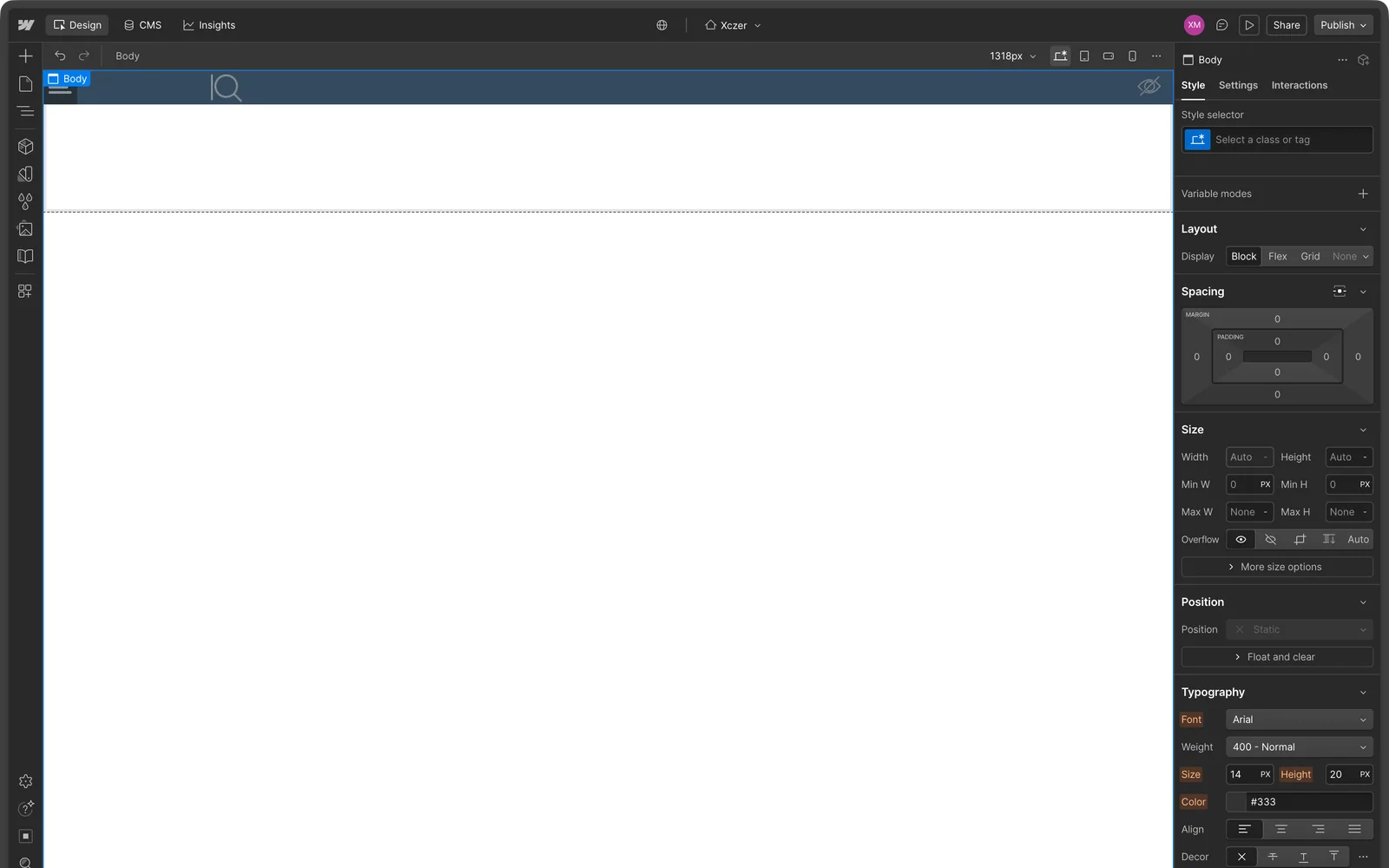
I was fourteen. Webflow had just launched its CMS feature, and I was early enough to be using it within weeks of the public release. The entire design came from scratch — not a template — because I wanted the thing to actually look like something I had made, not something I had downloaded and filled in. The visual editor was the medium; I was designing in the browser rather than exporting from Figma and hoping.
tawk.to embedded via Webflow's custom code block gave the blog a live chat widget. That was the decision that mattered structurally — it created the first surface where a reader could talk back directly. The blog had an author; the author was responsive. That bidirectional channel changed how I understood what a product actually is. A one-way broadcast is not the same thing.
What It Couldn't Solve
I wanted an animated low-poly background for the hero section. Webflow couldn't produce that from inside the visual editor, and embedding a canvas element with enough logic to generate triangle meshes fell outside what I could do with a code block alone. So I deferred it.
The deferred problem became the Trianglify jQuery plugin the following year — a standalone piece of public software built specifically because this blog had a visual requirement I couldn't meet at fourteen. That is how a constraint becomes a project: the original problem doesn't disappear, it waits until the skill exists to solve it.
What It Produced Alongside
I designed the first version of the unified logo system for this project. The Adobe product suite was the reference: one unmistakable master mark, colour and typographic variations per product. Rather than design a one-off logo for the blog, I designed a derivation rule that could produce a new mark for every project I would ever build. That system — one source of truth, per-product variants — is the same structural pattern I returned to later in shared component libraries and cross-platform monorepos.
The system has been in active use for over a decade. The blog that generated it lasted for years and was superseded by more capable architectures, each one informed by what the previous version couldn't do.
Did this resonate?
Love
Fire
Insightful
Clap
Thought-provoking
Comments
Loading comments...