Unified Logo System
Adobe-inspired master-mark-plus-derivation-rule brand system designed at 14 — still in active use a decade later
10+years in use
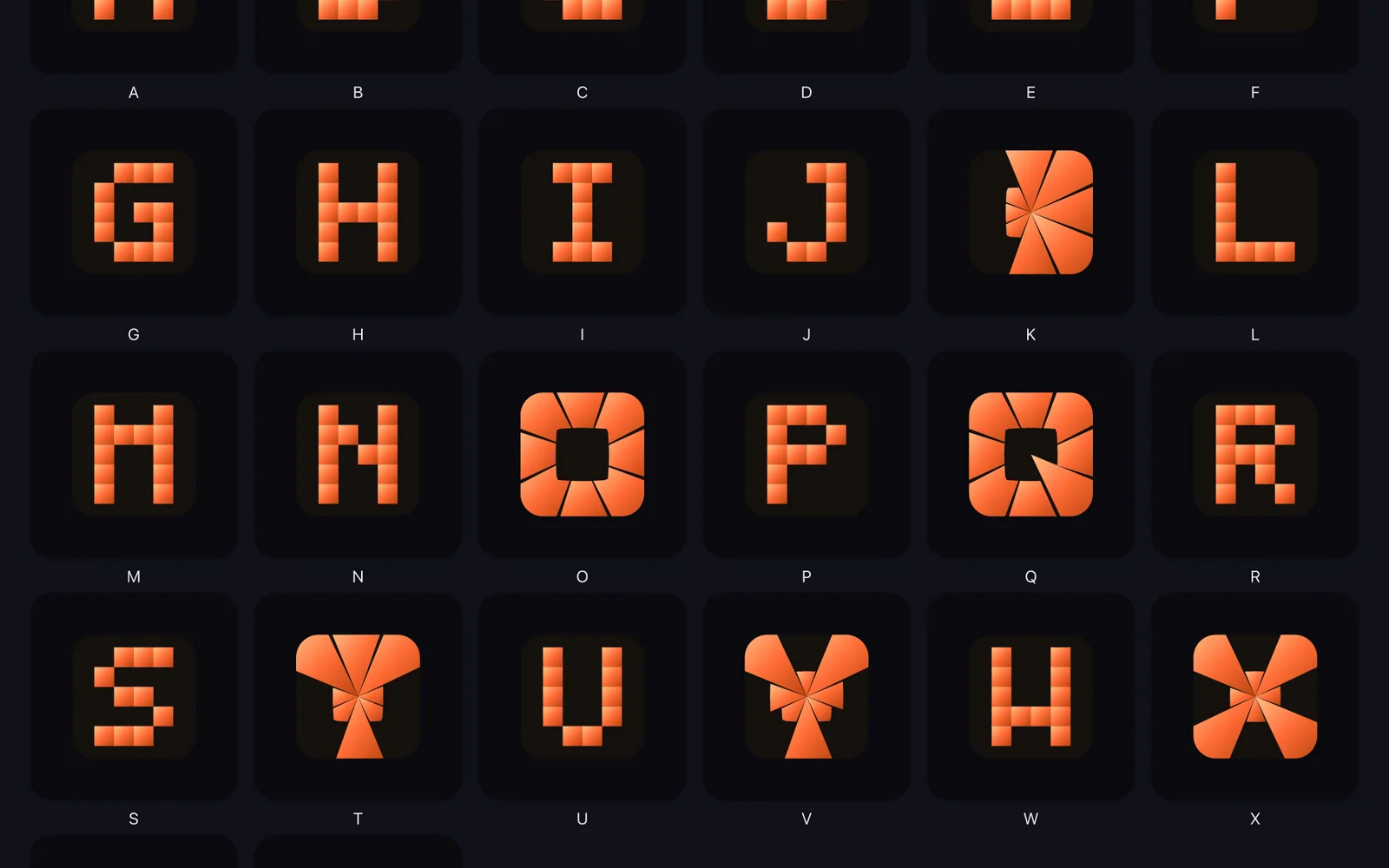
Designing for a Portfolio That Didn't Exist Yet
At fourteen, I was building my first product — the personal blog. The natural move would have been to design a logo for it and move on. Instead I designed a system that would cover everything I would ever build.
The reference was Adobe. Their product suite uses one unmistakable master mark and a derivation rule that produces per-product variants — different colour for Photoshop, different colour for Illustrator, same structural mark underneath. The variants are obviously siblings. The system holds across a hundred products because the rule is consistent, not because each product was designed in isolation.
I applied that logic at fourteen to a portfolio that had one product. The master mark came first — a geometric form that could hold its own at any size, on any background, in any colour. Then the derivation rule: how to produce a new mark for a new product by varying colour and typographic pairing while keeping the structural form constant.
A Design Pattern That Kept Proving Out
The system is still in active use more than a decade later, across more products than existed when I designed it. That longevity is the primary evidence of the structural decision being correct. A logo designed for one product would have been retired when that product was. A system designed around a derivation rule has no retirement date — it absorbs new products by applying the rule.
The pattern itself — one source of truth plus a derivation rule that produces context-specific outputs — is not unique to visual identity. It is the same pattern I returned to when designing the ott-components shared component library: one base component, variant props, platform-specific rendering. It is the same pattern in a cross-platform monorepo: one data contract, surface-specific adapters. I arrived at the pattern at fourteen through design, recognised it years later in engineering, and kept applying it in both domains because the same constraint — maintain consistency across many surfaces — produces the same structural answer.
No Code, No Repository
The unified logo system is a pure design artifact. There is no code to review, no commit history, no spec file. The master mark and derivation rules exist in a vector design tool, and new project identities are generated by applying the rule when a new project ships.
The system's value is demonstrated by the fact that it outlasted the tool used to create it, the products it first covered, and a decade of changes in what I build and how I build it. That is what a durable abstraction looks like: not the artifact, but the rule that produces the artifact.
Did this resonate?
Love
Fire
Insightful
Clap
Thought-provoking
Comments
Loading comments...