Xecute — Productivity Command Center
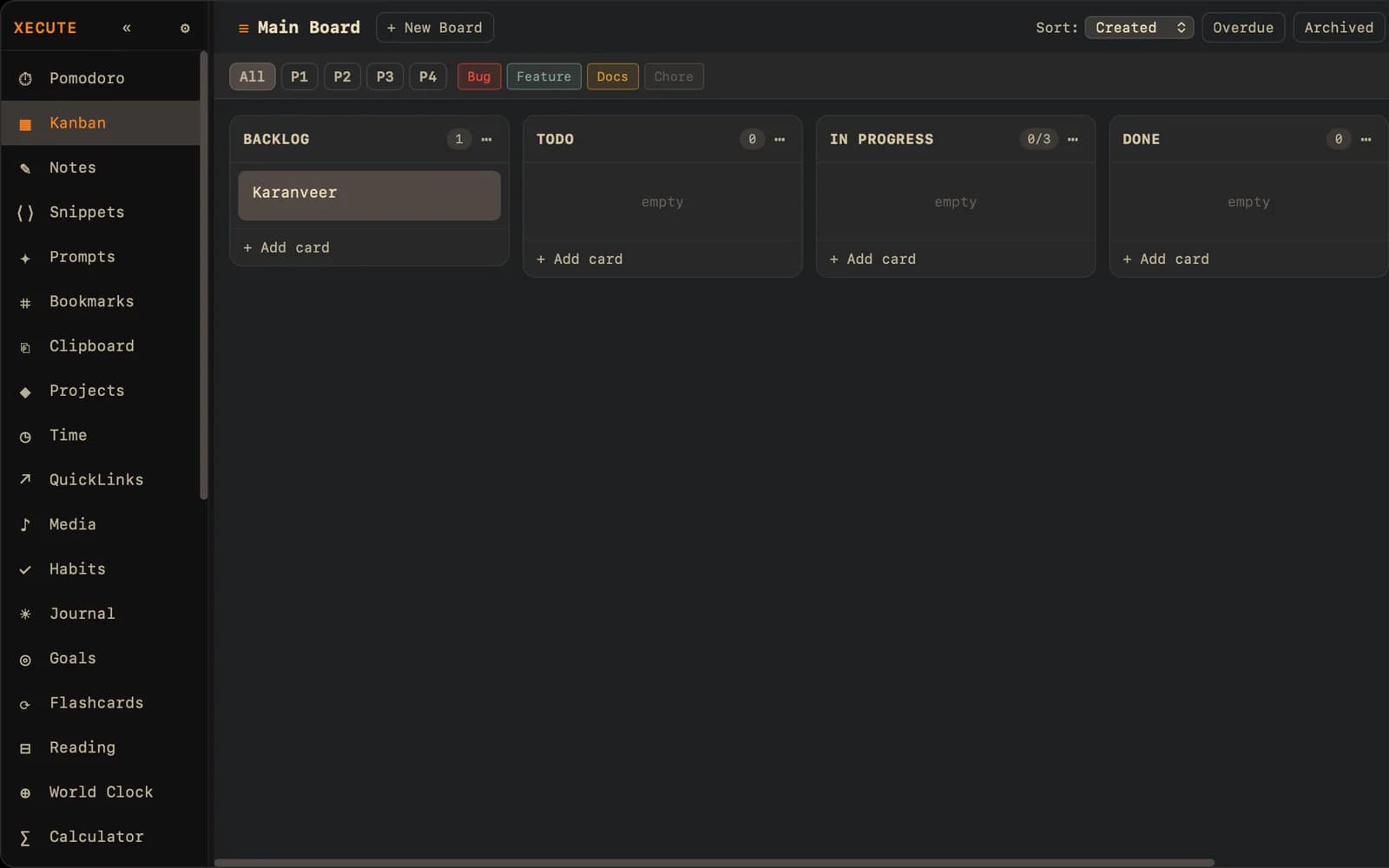
34-panel macOS productivity HUD with Kanban, Pomodoro, SM-2 flashcards, Fuse.js search, and 45k LOC
34panels
Tauri v2Svelte 5TypeScriptRustTailwind CSS v4Fuse.jsShikimarkedobjc2
The disconnection problem
For a while I used the obvious stack: Pomodoro timer in one app, time tracking in another, tasks in Notion, notes in Bear, vocabulary cards in Anki, clipboard manager running in the background. Each one was fine. None of them talked to each other.
What bothered me — really bothered me — is that this disconnection creates a false picture of how you actually work. A Pomodoro session and a time-tracked work block are the same event described in two systems. They should produce the same record automatically. They didn't, which meant I was either entering data twice or accepting that one system was always slightly out of sync. I was doing meta-work about my work. The overhead wasn't the app-switching; it was the cognitive cost of maintaining coherence across tools that should have been unified at the data layer.
PgDn from any application. Thirty-four panels. Every productivity tool I use daily, in one overlay, wired together. That's Xecute.
Cross-panel integration as the design thesis
The difference between Xecute and thirty-four apps bundled in a container is the integrations. When I finish a Pomodoro session, it automatically creates a Time Tracker entry — same duration, same task label, no second entry required. When I move a Kanban card to Done, the Standup panel picks it up for tomorrow's update. These are not features I added late. They were in the 1,026-line SPEC.md before any code existed, because retrofitting integrations into panels that were built independently is how you end up with special-case workarounds everywhere.
Writing the spec forced me to define integration contracts upfront: what is the shape of a "completed Pomodoro session" as a data structure, and which panels are allowed to read from it. Once that was settled on paper, the implementation was mechanical. The hard design work happened before I opened my editor.
SM-2 is a good example of the principle. Spaced repetition is a well-defined algorithm — there's no reason to implement it twice just because Flashcards and Vocabulary feel like different domains. I implemented it once, in a shared module with a clean interface, and both panels consume it. The result is consistent review scheduling, consistent ease-factor adjustments, and a unified review queue I can work through in a single session. If I had built them separately, I'd be managing two diverging SM-2 implementations indefinitely.
The objc2 lesson carried from CheaXheet
Xecute has a predecessor: CheaXheet, a simpler keyboard-shortcut overlay I built earlier. CheaXheet taught me the macOS keyboard-focus problem the hard way.
On macOS, when an app runs under ActivationPolicy::Accessory — which is what keeps it invisible in the Dock and Cmd+Tab switcher — it doesn't automatically become the key window when it appears. You bring up the overlay, start typing, and nothing happens because focus is still with whatever app you were in before. This is macOS doing exactly what you'd expect for an accessory process. It's also the wrong behavior for a text-input-heavy overlay.
The fix is to call NSApplication.activateIgnoringOtherApps via objc2 FFI, which explicitly takes focus. It's marked unsafe because you're bypassing Tauri's window management to reach AppKit directly. I was hesitant to do this in CheaXheet, tried several workarounds, and eventually accepted that none of them were reliable. By the time I started Xecute, the objc2 call was in the spec from day one. Knowing when to reach for the unsafe escape hatch — and why the safe alternatives fail — is the judgment that building CheaXheet bought me.
Honest caveats
Forty-five thousand lines of code, 84 source files, 34 panels. I want to be clear about what that means: Xecute works, I use it every day, and it is not finished. A personal tool at this scope is never truly finished — there's always a panel that could be more polished, an integration that could be deeper, a keyboard shortcut not yet wired. The Mind Map panel does what I need and nothing more. The Finance panel has the data model I want; the chart views are still on the roadmap.
What Xecute demonstrates is that integration is a first-class design decision, not an afterthought. The panels that feel most valuable — Pomodoro-to-TimeTracker auto-logging, the unified SM-2 engine, the Cmd+K cross-panel search — are valuable precisely because they were designed together from a shared spec. That's the thesis: disconnected tools aren't just inconvenient, they're architecturally wrong for how deep work actually flows across a day.
Did this resonate?
Love
Fire
Insightful
Clap
Thought-provoking
Comments
Loading comments...